Key Takeaways
- Understand the main differences between traditional and modern rice mills for better equipment selection.
- Choosing a reliable Rice Mill Manufacturer in India can significantly impact your milling operations.
- Modern rice mills offer integrated processing stages for more efficient workflows compared to traditional setups.
- Evaluate your paddy-processing requirements before selecting machinery from a Rice Mill Manufacturer.
- Modern rice mills can reduce manual handling and improve overall efficiency with connected systems.
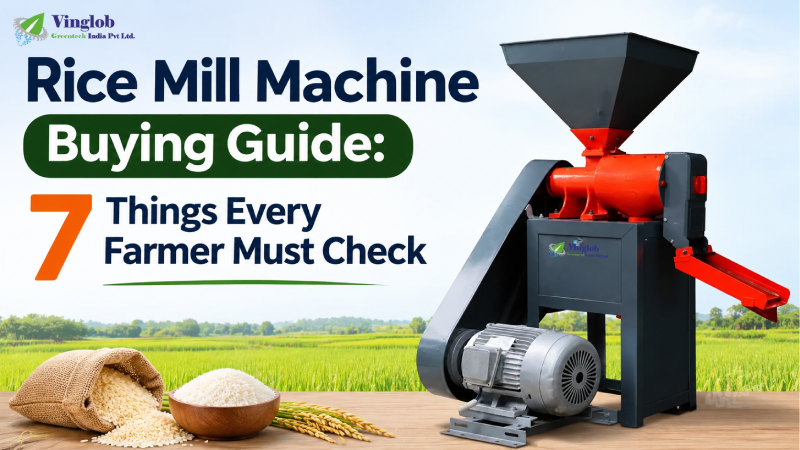
Vinglobe Greentech (I) Pvt. Ltd, is a leading manufacturer of rice mill and pulverizer machines. Rice milling has changed considerably from basic, labour-dependent processing to more integrated machine-based operations. For buyers comparing a Rice Mill Manufacturer in India, understanding the practical difference between traditional and modern rice mills can make machine selection much easier. Working with an experienced Rice Mill Manufacturer also helps buyers evaluate equipment according to their actual milling requirements.
What Is a Traditional Rice Mill?
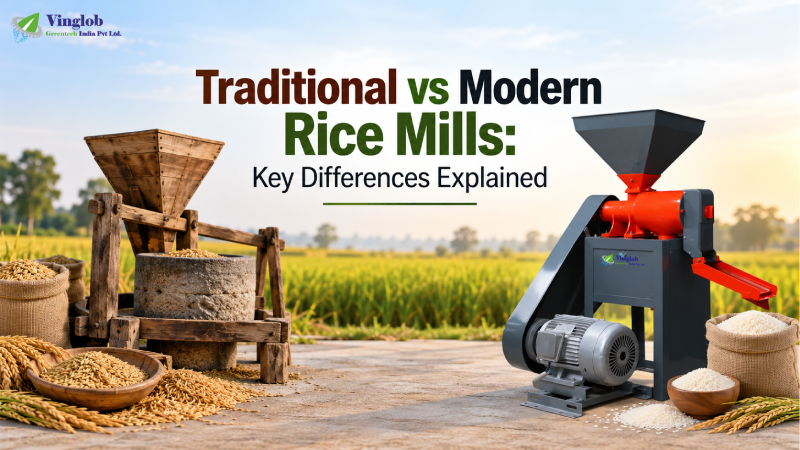
A traditional rice mill generally uses a simpler processing setup where several activities may depend on manual feeding, handling or separate machines. Paddy is processed through basic de-husking and related milling operations before the finished rice is collected.
Such mills can still be suitable where production requirements are limited and operators prefer straightforward machinery. However, when different processing stages require separate handling, the overall workflow can involve more operator attention and physical movement of the material.
Traditional systems may also have fewer integrated options for cleaning, grading, polishing and moving grain between different processing stages. The exact arrangement depends on the type and configuration of the mill.
What Is a Modern Rice Mill?
A modern rice mill uses a more organised processing arrangement in which multiple rice-processing functions can be combined or connected within one system. Depending on the selected model, these functions can include paddy cleaning, de-husking, polishing, grading and material movement.
The current product range associated with Vinglobe Greentech (I) Pvt. Ltd, includes semi-automatic de-husker and polisher machines as well as mini rice mill configurations featuring components such as destoners, graders and bucket elevators. One listed 6N70 configuration also incorporates a pulverizer.
For a commercial buyer, choosing a Rice Mill Manufacturer in India with different machine configurations makes it possible to select equipment according to the desired processing setup rather than relying on a single basic milling arrangement.
Traditional vs Modern Rice Mill: Main Differences
The most useful way to understand both systems is to compare how they approach the same rice-processing requirements.
|
Comparison Factor |
Traditional Rice Mill |
Modern Rice Mill |
|
Processing setup |
Basic or separately arranged operations |
More integrated processing stages |
|
Material handling |
Greater dependence on manual movement |
Can use elevators or connected handling systems |
|
Cleaning and grading |
May require separate equipment or steps |
Can include destoning and grading systems |
|
Operation |
More operator-dependent |
Semi-automatic or more organised machine operation |
|
Processing flexibility |
Suitable for straightforward milling |
Suitable for multi-stage paddy processing |
|
Commercial suitability |
Depends on scale and setup |
Better suited to organised commercial workflows |
The main difference is not simply the age of the equipment; it is how efficiently different milling stages are organised within the complete processing workflow.
Difference in Paddy Handling and Cleaning
Traditional milling setups may require paddy to be manually moved between cleaning, de-husking and other stages. This can be manageable for small operations, but the process becomes more dependent on operator involvement as production requirements increase.
Modern rice mills can incorporate equipment such as destoners and bucket elevators. A destoner helps separate unwanted material from the paddy, while an elevator moves material between stages with less manual handling.
When comparing equipment from a Rice Mill Manufacturer, buyers should therefore look beyond the basic milling unit and consider how paddy enters, moves through and exits the complete system.
De-Husking, Polishing and Grading
De-husking is one of the central operations in rice milling. Traditional machines may focus primarily on removing the husk, with polishing or grading handled separately depending on the mill arrangement.
Modern systems can combine more of these functions. VGT's listed product range, for example, includes semi-automatic de-husker cum polisher equipment as well as rice mill models incorporating graders.
Integrated processing can reduce the need to shift rice manually between multiple independent machines, making the milling workflow more organised for commercial operations.
Difference in Labour and Daily Operation
Traditional mills can require operators to supervise feeding, collection and movement of material across different stages. The level of labour required depends heavily on the mill layout and machinery being used.
Modern mills are designed around a more connected workflow. Semi-automatic operation, elevators and integrated processing components can reduce repeated manual material movement, although operators are still required for machine control, monitoring, feeding and routine maintenance.
A reliable Rice Mill Manufacturer in India should therefore be evaluated not only by the machine itself but also by how the complete configuration fits the buyer's available workforce and operating environment.
Which Rice Mill Is Better for Commercial Use?
There is no single configuration that suits every rice-processing business. A traditional setup may be adequate for a buyer with straightforward milling needs and an existing system for handling other stages independently.
A modern rice mill becomes particularly relevant when the buyer needs a more organised flow between cleaning, de-husking, polishing, separating and grading. It can also be appropriate for businesses planning to manage multiple processing stages within one coordinated setup.
Before purchasing from a Rice Mill Manufacturer, buyers should match machine features with their actual paddy-processing requirements rather than selecting equipment simply because it has more components.
What Should Buyers Check Before Choosing?
Before selecting a Rice Mill Manufacturer in India, commercial buyers should verify whether the proposed machine configuration matches their intended operation.
- Check whether the machine is designed for the required type of paddy-processing work.
- Confirm whether cleaning, de-husking, polishing and grading are included or require separate equipment.
- Check whether material-handling components such as an elevator are required for the planned setup.
- Review the motor and electrical phase requirements for the selected machine.
- Confirm the stated production capacity of the specific model being considered.
- Understand the operating mode, included components and routine maintenance requirements.
The website of Vinglobe Greentech (I) Pvt. Ltd, currently lists rice mill options ranging from de-husker and polisher machines to larger mini rice mill configurations with destoners, graders and elevators, giving buyers different configurations to evaluate according to their operation.
Why Choose Us
At Vinglobe Greentech (I) Pvt. Ltd, we understand that buyers need rice milling equipment that matches their production process and operating requirements. As a Rice Mill Manufacturer, we offer different rice mill configurations covering de-husking, polishing, cleaning, grading and connected material handling options. Our range allows agricultural businesses, rice processors and commercial buyers to compare equipment based on the processing functions they actually require rather than choosing a one-size-fits-all setup.
Conclusion
Traditional rice mills remain relevant for straightforward milling arrangements, while modern rice mills bring more processing stages into an organised system. Features such as de-husking, polishing, destoning, grading and material handling can make modern equipment suitable for commercial operations requiring a coordinated workflow. Vinglobe Greentech (I) Pvt. Ltd, provides multiple rice milling configurations for different operational needs. When selecting a Rice Mill Manufacturer, buyers should compare the complete processing setup, required capacity, operating mode and included components before making a purchase decision.
Looking for a dependable Rice Mill Manufacturer in India for your agricultural or commercial rice-processing requirements? Discuss your required rice mill configuration and application with our team today.
Call: +91 990 979 3721
Email: vinglobgreentech@gmail.com
Contact us today to select a suitable rice milling solution for your business requirements.
Frequently Asked Questions
What are the main differences between traditional and modern rice mills?
The main differences lie in the processing setup and efficiency. Traditional rice mills often rely on manual operations and have separate stages for cleaning, de-husking, and polishing, while modern rice mills integrate these functions into one organized system. This reduces the need for manual handling and increases processing speed.
Which rice mill is better for commercial use?
For commercial use, modern rice mills are generally more suitable as they offer a coordinated workflow and can handle larger production volumes. Traditional mills may suffice for smaller operations or straightforward milling needs, but modern setups provide more flexibility and efficiency.
Why should I choose Vinglobe Greentech as my rice mill manufacturer in India?
Vinglobe Greentech (I) Pvt. Ltd is a leading rice mill manufacturer in India, offering a variety of rice mill configurations that cater to different processing needs. Our machines include features like de-husking, polishing, and integrated material handling, ensuring that you find equipment that matches your operational requirements.
What should I check before purchasing a rice mill from a manufacturer?
Before purchasing, verify if the machine configuration aligns with your paddy-processing needs. Check for included components like cleaning and grading systems, assess material-handling requirements, and understand the motor specifications and production capacity of the model you're considering.
How has rice milling technology evolved over the years?
Rice milling technology has shifted from traditional, labor-intensive methods to modern, machine-based systems that enhance efficiency and integration. Modern rice mills can perform multiple functions such as cleaning, de-husking, and grading within a single workflow, making them more suitable for commercial operations.